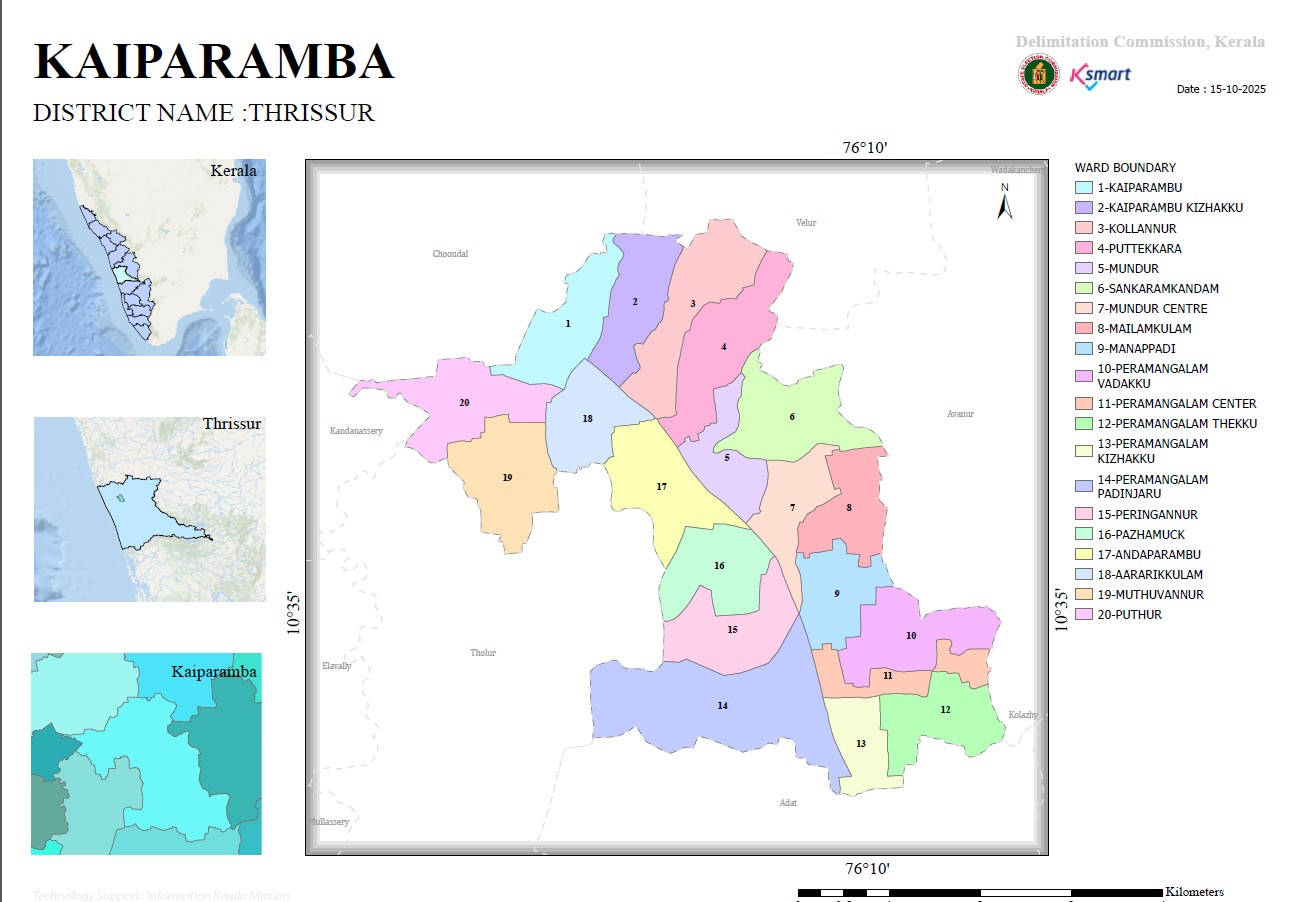
🌍 Kaiparambu Grama Panchayat: Geography and Features
Kaiparambu Grama Panchayat holds a distinct identity within the cultural and developmental landscape of the Thrissur district.
📍 Location and Area
Taluk / Block: Located in Thrissur Taluk, under the Puzhakkal Block.
Included Villages: Spans across the villages of Kaiparambu, Anjoor, and Peramangalam.
Total Area: 20.48 square kilometers.
Wards: Divided into 18 wards.
Headquarters: Situated at Mundur, which is located about 10 kilometers west of Thrissur city.
🗺️ Geographical Boundaries
East: Avanur and Velur Panchayats
West: Tholur Panchayat
South: Adat Panchayat
North: Choondal Panchayat
✨ Key Highlights and Specialities
Diamond Processing Hub: While the influence of modernization is highly evident, Kaiparambu seamlessly preserves its traditional rural charm. Notably, it holds the first position in Kerala within the diamond processing sector, shining bright in the global market.
Satellite Town of Thrissur: Driven by its unique appeal, the affluent and middle-class populations from the city have widely chosen to settle down permanently here, effectively turning Kaiparambu into a major satellite town of Thrissur.
Historical Milestone (First Grama Sabha): Following the implementation of the three-tier Panchayat Raj system, the Grama Sabha held on November 5, 1995, at the Cherukurumbakavu Temple ground in Mundur Vadakkumuri made history as the very first Grama Sabha in the state of Kerala.
Biodiversity at Ayyamkunnu: Despite being an area with a rising population density, Ayyamkunnu, located in the highest region of the panchayat at Mundur Vadakkumuri, serves as a natural habitat for peacocks. This scenic terrain is rich in biodiversity, boasting various trees, medicinal plants, peacocks, and rabbits.
📜 Origin of Place Names
Anjoor: In ancient times, the administration of the village assembly was managed by a Nair military clan known as the Anjoottavar. The name 'Anjoor' directly originated from this group.
Kaiparambu: The name translates to a high terrain (Parambu) where bullock carts historically had to be manually pushed up by hand (Kai). A specialized group of people known as Kaiparambi was officially employed during that era specifically to push these bullock carts up the steep incline.